LibreNMS Pinned at 100% CPU — MariaDB Stuck on Daylight Time
A hard-coded UTC offset in MariaDB put the database clock an hour ahead after DST ended, so LibreNMS treated every device as overdue and polled non-stop.
- Systems
- LibreNMSMariaDBProxmox
- Severity
- high
- Time to resolve
- ~1 hour
- Related project
- Observability: Metrics, Logs, and Config Backup
Summary
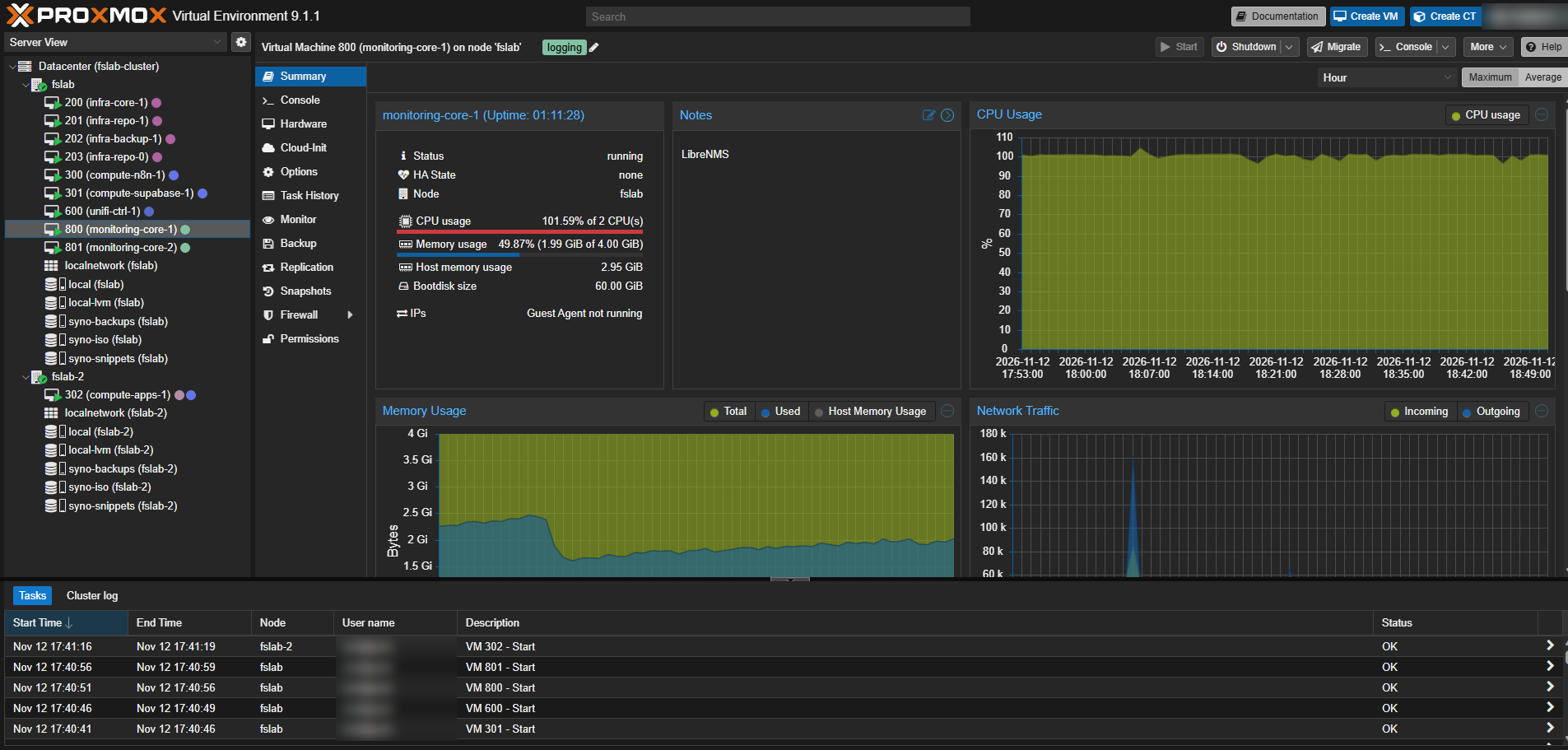
The VM running LibreNMS (monitoring-core-1, 2 vCPU / 4 GB) sat at ~100% CPU with a load average of ~10.
The cause wasn’t load or a bad device — MariaDB was configured with a fixed -04:00 offset (EDT). When daylight
saving time ended on November 1, the database clock stayed an hour ahead of the OS and PHP. Every device’s
last_polled timestamp looked an hour old, so the LibreNMS dispatcher re-polled all 13 devices the instant each
poll finished.
Result after the fix: load average dropped from ~10 → 0.3, and polling returned to normal 5-minute bursts.
Symptoms
- Proxmox CPU graph for the VM flat at ~100% for over an hour.
uptimeinside the VM:load average: 9.68, 10.04, 10.01on 2 vCPUs.- 13
lnms device:pollprocesses running at once, and the same device polled twice simultaneously. validate.phpreported everything[OK]— no obvious misconfiguration.
Investigation
I worked from the outside in, ruling out one layer at a time.
1. Host or guest?
On the Proxmox host, the VM’s kvm process was at 200% (both vCPUs saturated) while the host load was only
~2.7 on 12 threads. The host wasn’t contended — the load was real and inside the guest.
2. Which process?
Inside the guest, ps --sort=-%cpu showed a wall of php /opt/librenms/lnms device:poll processes plus MariaDB.
Oxidized, Bacula and everything else were idle.
3. Is a device just slow?
SELECT device_id, hostname, os, last_polled_timetaken
FROM devices ORDER BY last_polled_timetaken DESC;
The slowest device (a Catalyst switch) took ~24 s; most took ~5 s. Total work was ~85 seconds per 5-minute cycle — nowhere near enough to peg the CPU. Something was polling far more often than every 5 minutes.
4. Is something polling twice?
No legacy cron poller (/etc/cron.d/librenms didn’t exist), exactly one librenms-service.py dispatcher, and only
the normal scheduler timer. But the dispatcher log showed the smoking gun:
18:56:54  Completed poller run for 4 in 6.10s
18:56:54  Polling device 4
18:57:01  Completed poller run for 4 in 6.42s
18:57:01  Polling device 4
Each device was re-queued immediately after finishing. The dispatcher believed every device was overdue.
5. Why does every device look overdue?
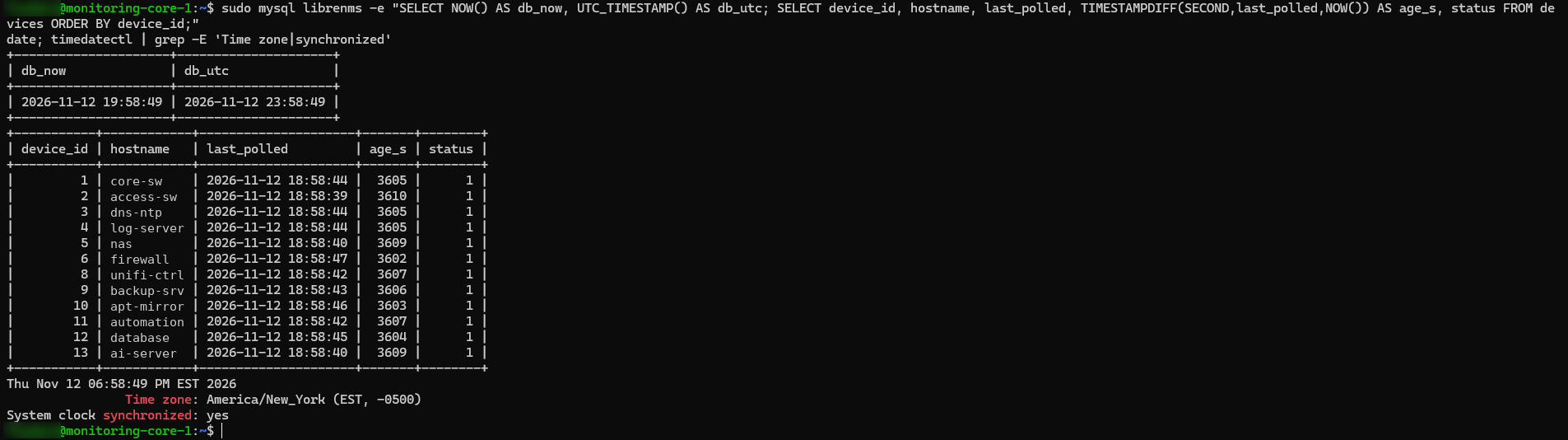
SELECT NOW() AS db_now, UTC_TIMESTAMP() AS db_utc;
SELECT device_id, TIMESTAMPDIFF(SECOND, last_polled, NOW()) AS age_s FROM devices;| Value | Reading |
|---|---|
OS date |
18:58:49 EST |
MariaDB UTC_TIMESTAMP() |
23:58:49 (correct) |
MariaDB NOW() |
19:58:49 — one hour ahead |
age_s for every device |
~3605 seconds |
Devices polled seconds earlier looked an hour stale.
SELECT @@global.time_zone, @@system_time_zone;
-- -04:00 | EST
/etc/mysql/mariadb.conf.d/50-server.cnf:20: default_time_zone = '-04:00'Root Cause
MariaDB had a hard-coded UTC offset (-04:00) instead of following the system timezone. A fixed offset doesn’t
change for daylight saving time, so when EDT ended the database clock drifted an hour ahead of the OS.
PHP writes last_polled in the correct local time, but the Python dispatcher compares it against MariaDB’s NOW() —
so every device permanently looked ~3600 seconds overdue against a 300-second polling interval.
Why validate.php missed it: LibreNMS’s PHP layer sets its own session timezone on each DB connection, so
PHP-vs-MySQL time checks matched. The Python dispatcher doesn’t, so it inherited the wrong global setting.
Fix
# 1. Correct the running server immediately (no restart needed)
sudo mysql -e "SET GLOBAL time_zone = 'SYSTEM';"

# 2. Persist it: back up and comment out the fixed offset
sudo cp /etc/mysql/mariadb.conf.d/50-server.cnf{,.bak.$(date +%F)}
sudo sed -i -E "s|^(\s*default[-_]time[-_]zone\s*=.*)|# \1|" /etc/mysql/mariadb.conf.d/50-server.cnf

# 3. Prove it survives a restart, then reconnect the dispatcher
sudo systemctl restart mariadb
sudo mysql -e "SELECT NOW(), @@global.time_zone;"; date
sudo systemctl restart librenms
I also lowered the dispatcher’s concurrency from the default 24 to 4 workers — a better fit for 2 vCPUs so polls don’t fight each other during each 5-minute burst:
sudo -u librenms lnms config:set service_poller_workers 4Verification
| Check | Before | After |
|---|---|---|
MariaDB time_zone |
-04:00 |
SYSTEM (persists across restart) |
NOW() vs date |
+1 hour | identical |
Device age_s |
~3605 s | 0–300 s |
| Concurrent polls | 13, constantly | ≤ 4, in 5-minute bursts |
| Load average (2 vCPU) | ~10 | 0.3 |
| Proxmox CPU graph | flat ~100% | short spikes every 5 min |
Lessons Learned
- Never hard-code a UTC offset in a database. Use
SYSTEMor a named zone (America/New_York) so DST is handled automatically. A fixed offset is a time bomb that goes off twice a year. - “All checks pass” isn’t proof. The validator tested the PHP path; the broken path was the Python dispatcher.
- Do the math on the workload. ~85 s of polling per 5 minutes can’t explain 100% CPU — that mismatch pointed at frequency, not cost.
- Compare timestamps from every layer. OS, database
NOW(), and database UTC side by side exposed the problem in one query. - Isolate layer by layer: host → guest → process → workload → scheduling → time. Each step ruled something out before moving on.